
If you’ve searched “what is wig patch” or “wig patch means” and ended up more confused than when you started, you’re not alone. This is one of the most commonly misunderstood pairs of terms in hair restoration — and the confusion is doing real harm, because people often choose the wrong solution simply because they didn’t know there was a difference.
Let’s clear it up properly.
The short answer
A wig is a complete head of hair you wear like a cap — it sits on top of your head and can be put on or taken off in seconds. A hair patch (also called a hair system, hair unit, or hair piece) is a smaller, targeted piece designed to cover a specific bald or thinning area, and it’s usually attached more securely to blend with your remaining natural hair.
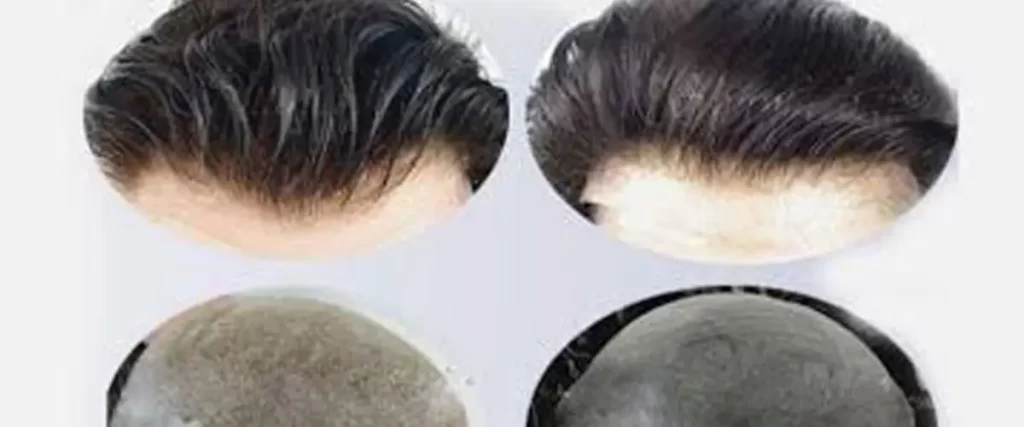
In one line: wigs cover the whole scalp, hair patches cover a part of it.
That’s the core difference. But the “why does it matter” part is where most people get it wrong — and where the right choice can make or break how natural you actually look.
What exactly is a wig?
A wig is a full head covering made from human hair, synthetic fibre, or a blend of both, built on a cap base. It’s designed for people who have lost most or all of their hair — whether from complete baldness, severe alopecia, or hair loss due to chemotherapy.
Wigs are:
- Full-coverage — they replace your entire head of hair, not just a section
- Removable on demand — most wigs can be taken off in under a minute, no special tools needed
- Available in human hair or synthetic — human hair wigs look more natural and can be styled with heat tools; synthetic wigs hold their shape but have a shorter lifespan
- Not customised to your remaining hair — because there usually isn’t much remaining hair to blend with
Wigs make the most sense when there’s little to no natural hair left to work with, or when someone wants the flexibility to switch styles or looks frequently without commitment.
What exactly is a hair patch?
A hair patch — sometimes called a hair system, hair unit, or toupee — is a smaller, precision-made piece designed to cover a specific bald patch, receding hairline, or thinning crown, while blending seamlessly into your existing hair.
Hair patches are:
- Partial coverage, custom-fitted — made to match the exact size and shape of your bald area
- Blended with your natural hair — the patch is colour-matched and textured to merge invisibly with the hair you still have
- Attached more securely — using methods like bonding (adhesive), weaving (braided base), or a silicone/skin system, depending on how active your lifestyle is
- Designed to look undetectable — a well-fitted patch from your existing hairline outward is very hard to spot, even up close
Hair patches make the most sense for people experiencing partial baldness or thinning — male pattern baldness, a receding hairline, or a thinning crown — where there’s still natural hair to work with and blend into.
Wig vs hair patch — side by side
| Wig | Hair patch | |
|---|---|---|
| Coverage | Entire scalp | A specific bald or thinning area |
| Best for | Complete or near-complete hair loss | Partial baldness, thinning, receding hairline |
| Attachment | Worn like a cap, easily removable | Bonded, woven, or fixed to scalp/existing hair |
| Blending with natural hair | Not applicable (no hair to blend with) | Custom-matched and blended with remaining hair |
| Daily removal | Yes, takes seconds | Depends on the system — some are detachable, some are long-wearing |
| Activities (swimming, gym, etc.) | Can shift or need adjusting | Many systems are designed to stay secure through normal activity |
| Customisation | Available off-the-shelf or custom | Always custom-fitted to your scalp and hair |
So which one do you actually need?
Ask yourself one simple question: do I have natural hair left, or not?
- If most of your scalp is bald with little to no hair around it, a wig (or a full-cap hair system) is usually the better fit — there’s nothing to blend with, so a hair patch isn’t the right tool.
- If you have thinning, a receding hairline, or one or two bald patches, a hair patch is almost always the more natural-looking choice. It works with your existing hair instead of around it, and a well-fitted patch is genuinely difficult for anyone to notice.
This is also why search terms like “wig patch” and “patch wig” cause so much confusion — people use them interchangeably, but they actually point to two different solutions for two different situations. Getting this wrong means either covering hair you didn’t need to cover, or trying to “patch” an area when you actually need full coverage.
Why hair patches are usually the better choice for partial baldness
For the most common type of hair loss — male pattern baldness, thinning crowns, receding hairlines — a hair patch typically gives a more natural result than a wig, for a few reasons:
- It blends, not covers. A patch is matched to your hair colour, texture, and growth direction, so it looks like your hair is simply still there — not like something has been placed on top of it.
- It’s more secure for daily life. Depending on the attachment method (bonding, weaving, or silicone systems), you can shower, exercise, swim, and sleep without worrying about it shifting.
- It doesn’t require touching the hair you still have. Unlike a transplant, there’s no surgery, no recovery time, and zero risk to your existing natural hair.
This is exactly the kind of non-surgical hair replacement that Nile Hair Care specialises in — custom hair patches, hair bonding, hair weaving, and silicone hair systems, all fitted and styled to match your natural hairline.
Frequently asked questions
No. A wig covers your entire scalp and is meant to be worn like a removable cap. A hair patch is a smaller, custom-fitted piece designed to cover a specific bald or thinning area while blending with your remaining natural hair.
Yes — in fact, that’s exactly what a hair patch is designed for. It blends with your existing hair rather than replacing all of it, which is why it tends to look more natural for partial baldness than a full wig would.
Still not sure which is right for you?
The wig-vs-patch question really comes down to how much natural hair you have left to work with — and that’s easiest to assess in person. At Nile Hair Care, we offer a free consultation at our Koramangala and Bellandur clinics in Bangalore to assess your hair and recommend the right non-surgical solution, whether that’s a custom hair patch, hair bonding, hair weaving, or a full hair system.
Call us at 9916489443 or visit our Koramangala or Bellandur clinic for a no-obligation assessment.