
Running your fingers through your hair and finding strands coming out. Noticing your ponytail feels thinner than it used to. Seeing more scalp visible through your part. Feeling a wave of anxiety every time you look in the mirror.
If you’re a woman experiencing hair loss, you know it’s not just about losing hair—it’s about losing a part of your identity, your confidence, and how you see yourself.
Hair loss in women is far more common than most people realize. While society often talks about male baldness, female hair loss remains a silent struggle that affects millions of women in India and worldwide. The difference is that women often suffer in silence, feeling isolated and unsure where to turn for help.
At Nile Hair N Skin Care in Bangalore, we understand the unique emotional and physical impact of female hair loss. We’ve helped hundreds of women navigate their hair loss journey, from understanding what’s causing it to finding solutions that restore both their hair and their confidence.
This comprehensive guide will help you understand why women lose hair, the different types of female hair loss, and the most effective non-surgical solutions available in Bangalore today.
Why Hair Loss in Women Is Different
Before we dive into causes and solutions, it’s important to understand that hair loss affects women differently than men—both physically and emotionally.
The physical differences: Women rarely experience complete baldness. Instead, female hair loss typically shows up as diffuse thinning across the entire scalp, widening of the part line, or reduced hair volume and density. The frontal hairline usually stays intact, unlike male pattern baldness.
The emotional impact: For women, hair is deeply connected to femininity, beauty, identity, and self-expression. Society places enormous pressure on women to have thick, healthy hair. When that changes, it can feel devastating.
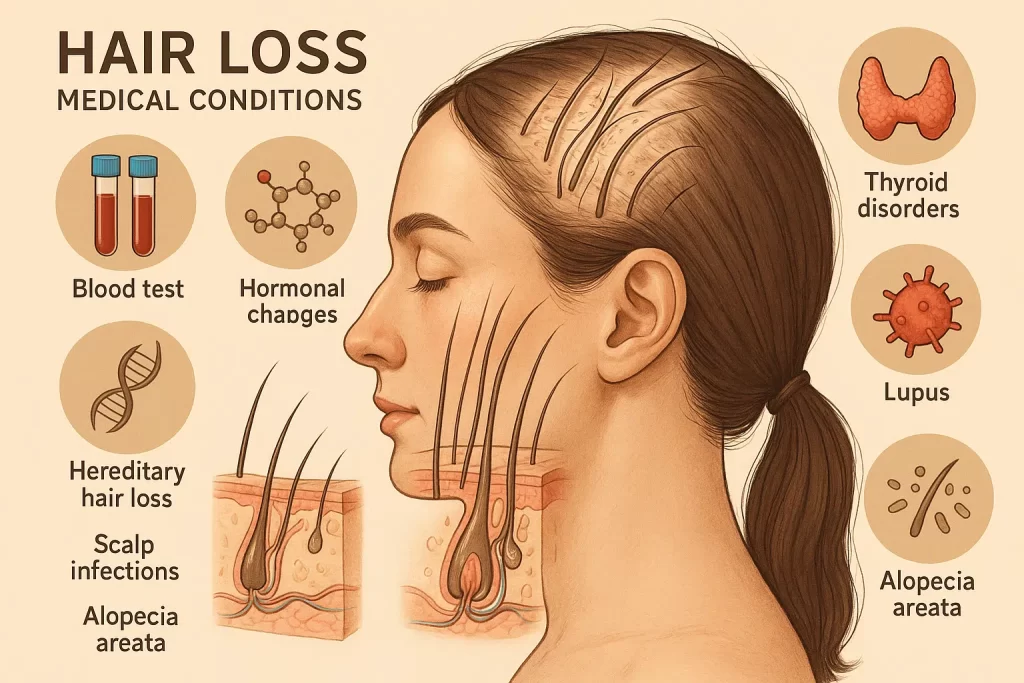
Studies show that women with hair loss experience higher rates of anxiety, depression, reduced self-esteem, and social withdrawal compared to men with similar hair loss. This isn’t vanity—it’s a genuine psychological impact that deserves recognition and support.
The good news: Most causes of female hair loss are treatable or manageable. With proper diagnosis and the right approach, many women see improvement, and for those who don’t, highly effective cosmetic solutions exist that look completely natural.
The Most Common Causes of Hair Loss in Women
Female hair loss isn’t one condition—it’s a symptom with many possible causes. Let’s break down the most common reasons women lose hair.
1. Hormonal Changes: The Primary Culprit
Hormones play a massive role in female hair health. When hormones fluctuate or become imbalanced, hair often pays the price.
PCOS (Polycystic Ovary Syndrome)
PCOS affects millions of women worldwide and is characterized by an excess of androgens (male hormones like testosterone and DHT). This hormonal imbalance triggers a type of hair loss called androgenetic alopecia.
What you’ll notice with PCOS-related hair loss:
- Diffuse thinning over the top and crown of the scalp
- Widening part line where more scalp becomes visible
- Smaller, finer hairs in affected areas
- Frontal hairline usually remains intact
- Often accompanied by other PCOS symptoms: irregular periods, acne, unwanted facial hair, weight gain
The prevalence of androgenic alopecia in PCOS varies from 40-70%, with some women showing signs in their teens.
The irony of PCOS is cruel: while losing hair on your head, you may develop unwanted hair growth on your face, chest, or back due to the same hormonal imbalance.
Postpartum Hair Loss
After delivery, estrogen and progesterone levels rapidly decline, contributing to postpartum hair loss, also known as postpartum telogen effluvium (PPTE).
During pregnancy, elevated estrogen levels keep hair in the growth phase longer, giving you that thick, lustrous “pregnancy hair.” After childbirth, when hormone levels crash, all that hair enters the resting phase simultaneously.
PPTE typically begins about two to five months after childbirth and is usually self-limited.
What to expect:
- Sudden, dramatic shedding 2-5 months after delivery
- Hair coming out in clumps when brushing or washing
- Thinning most noticeable at the temples and hairline
- Typically resolves within 6-12 months as hormones rebalance
Menopause and Perimenopause
Menopause is characterized by a significant reduction in estrogen levels that leads to hair thinning, loss of volume, and texture changes affecting up to 50% of women.
As estrogen declines, the relative balance shifts toward androgens, which can shrink hair follicles over time. Additionally, lower estrogen means hair spends less time in the growth phase.
What you’ll notice:
- Gradual thinning that becomes more noticeable over months or years
- Hair texture changes—drier, coarser, more brittle
- Reduced volume and density
- Slower hair growth
- More visible scalp, especially at the crown and part line
About 50 percent of women going through the menopause transition, and around 80 percent of postmenopausal women, experience hair loss.
Thyroid Disorders
Both hypothyroidism (underactive thyroid) and hyperthyroidism (overactive thyroid) can trigger hair loss. Thyroid hormones directly influence hair follicle function and the hair growth cycle.
What you’ll notice:
- Diffuse thinning across the entire scalp
- Hair loss not just on your head but also eyebrows, eyelashes, and body hair
- Changes in hair texture
- Other thyroid symptoms: fatigue, weight changes, temperature sensitivity, mood changes
The good news: thyroid-related hair loss is usually reversible once thyroid hormone levels are normalized with medication.
2. Female Pattern Hair Loss (Androgenetic Alopecia)
This is the most common type of progressive hair loss in women, affecting approximately 40% of women by age 50.
Unlike male pattern baldness with its receding hairline and bald spots, female pattern hair loss shows up as:
- Diffuse thinning over the crown and top of the scalp
- Widening of the center part
- Preserved frontal hairline
- Gradual progression over years
The Ludwig Scale describes three stages:
- Stage 1: Small areas of thinning with some thin hairs among healthy ones
- Stage 2: Noticeable bald patches and many thin hairs
- Stage 3: Extensive thinning with almost invisible, fuzzy hair
Causes include genetics, hormonal factors, and aging. If your mother, grandmother, or sisters experienced hair thinning, you’re at higher risk.
3. Telogen Effluvium: Stress-Related Shedding
This temporary condition causes widespread hair shedding triggered by physical or emotional stress.
Common triggers:
- Severe illness, high fever, or infection
- Major surgery or hospitalization
- Extreme emotional stress or trauma
- Rapid weight loss or crash dieting
- Starting or stopping certain medications
- Nutritional deficiencies
The timeline: Hair shedding typically begins 2-3 months after the triggering event and can last 3-6 months. Most cases resolve on their own once the trigger is removed.
4. Alopecia Areata
An autoimmune condition where your immune system attacks hair follicles, causing sudden patches of hair loss.
What you’ll notice:
- Sudden round or oval bald patches
- Smooth skin with no redness or scaling
- Can occur on scalp, eyebrows, or anywhere on the body
- Sometimes nail changes (pitting, ridges)
Women with other autoimmune conditions like thyroid disease, vitiligo, or lupus are at higher risk.
5. Nutritional Deficiencies
Your hair needs proper nutrition to grow. Deficiencies in key nutrients can trigger hair loss.
Critical nutrients for hair health:
- Iron: Especially important for women with heavy menstrual periods
- Protein: Hair is made of protein; severe restriction causes shedding
- Vitamin D: Deficiency linked to various hair loss conditions
- Biotin: Supports healthy hair growth
- Zinc: Essential for hair tissue growth and repair
- Omega-3 fatty acids: Support scalp health
6. Traction Alopecia
Hair loss caused by repeated pulling or tension on hair follicles from tight hairstyles.
High-risk hairstyles:
- Tight ponytails or buns
- Braids, especially cornrows
- Hair extensions or weaves
- Tight headbands or hair accessories
What you’ll notice:
- Thinning along the hairline, temples, or wherever tension is applied
- Broken hairs
- Tender scalp
- Gradual progression if hairstyle habits continue
The good news: if caught early, stopping the damaging practices allows hair to regrow.
7. Medical Conditions and Medications
Certain health conditions and medications can cause hair loss:
Medical conditions:
- Lupus and other autoimmune diseases
- Iron deficiency anemia
- Eating disorders
- Scalp infections
- Chronic illnesses
Medications that may cause hair loss:
- Some birth control pills
- Antidepressants
- Blood pressure medications
- Cholesterol-lowering drugs
- Anti-inflammatory drugs
- Chemotherapy (causes dramatic but usually temporary hair loss)
Types of Female Hair Loss: Understanding Your Pattern
Hair loss in women generally falls into two categories:
Non-scarring alopecia (hair can regrow):
- Female pattern hair loss
- Telogen effluvium
- Alopecia areata
- Traction alopecia (if caught early)
- Hormone-related hair loss
Scarring alopecia (permanent follicle damage):
- Frontal fibrosing alopecia
- Central centrifugal cicatricial alopecia
- Lichen planopilaris
Understanding which type you have is crucial because it determines both treatment options and prognosis.
How to Determine What’s Causing YOUR Hair Loss
If you’re experiencing hair loss, here’s how to start identifying the cause:
1. Look at the pattern:
- Diffuse thinning all over? Could be hormonal, nutritional, or stress-related
- Widening part with preserved hairline? Likely female pattern hair loss
- Sudden round patches? Probably alopecia areata
- Thinning at temples and hairline? Check for traction or frontal fibrosing alopecia
2. Consider the timeline:
- Sudden onset? Think stress, medication change, or autoimmune
- Gradual over years? Likely pattern hair loss or hormonal
- Started 2-3 months after a major event? Telogen effluvium
3. Review recent life events:
- Childbirth in the last 6 months?
- Major stress, illness, or surgery?
- Started or stopped medications?
- Significant weight loss?
- Dietary changes?
4. Check for other symptoms:
- Irregular periods, acne, unwanted hair growth? Get tested for PCOS
- Fatigue, weight changes, feeling cold/hot? Check thyroid
- Nail changes, joint pain, skin rashes? Consider autoimmune conditions
5. Evaluate your family history:
- Do female relatives have thin hair?
- Any family history of autoimmune diseases?
- Pattern of hair loss similar to your mother or grandmother?
Getting Professional Diagnosis: What to Expect
Self-diagnosis only gets you so far. Professional evaluation is essential for accurate diagnosis and effective treatment.
What happens during a hair loss consultation:
Detailed medical history: Your doctor will ask about menstrual cycles, pregnancies, medications, diet, stress levels, family history, and when you first noticed hair loss.
Scalp examination: Visual inspection of your scalp, hair density, and pattern of thinning. Your doctor may use a dermatoscope for closer examination.
Pull test: Gentle tugging on small sections of hair to see how many strands come out easily. This helps assess active shedding.
Blood tests: Common tests include:
- Complete blood count (checking for anemia)
- Thyroid function (TSH, T3, T4)
- Iron and ferritin levels
- Vitamin D, B12
- Hormone levels (testosterone, DHEA-S if PCOS suspected)
- ANA (autoimmune markers if alopecia areata suspected)
Scalp biopsy (if needed): In unclear cases, a small scalp sample may be examined under a microscope.
Where to get evaluated in Bangalore: Start with a dermatologist or trichologist (hair specialist). At Nile Hair N Skin Care, we offer comprehensive hair loss evaluations and can guide you through the diagnostic process.
Medical Treatment Options for Female Hair Loss
Treatment depends entirely on the underlying cause. Here are the main medical approaches:
For Female Pattern Hair Loss:
- Minoxidil (Rogaine): The only FDA-approved topical treatment for women, available in 2% or 5% solution
- Spironolactone: An anti-androgen medication that can help reduce hair loss
- Oral contraceptives: Birth control pills can help regulate hormones
- Low-level laser therapy: Devices that stimulate hair follicles
- Platelet-rich plasma (PRP): Injections of your own concentrated platelets to stimulate growth
For PCOS-Related Hair Loss:
- Anti-androgen medications
- Metformin to regulate insulin
- Birth control pills
- Lifestyle modifications (diet, exercise, weight management)
For Thyroid-Related Hair Loss:
- Thyroid hormone replacement therapy
- Regular monitoring to maintain optimal levels
For Telogen Effluvium:
- Address underlying trigger
- Nutritional support
- Stress management
- Usually resolves on its own once trigger is removed
For Alopecia Areata:
- Corticosteroid injections
- Topical immunotherapy
- JAK inhibitors (newer medications)
For Nutritional Deficiencies:
- Targeted supplementation
- Dietary improvements
- Addressing absorption issues
Non-Surgical Hair Replacement Solutions in Bangalore
Medical treatments work for many women, but they take time—often 6-12 months before seeing results. Some causes of hair loss don’t respond well to treatment. And some women simply want an immediate solution while pursuing medical treatment.
This is where non-surgical hair replacement becomes invaluable.
At Nile Hair N Skin Care, we specialize in advanced non-surgical solutions that provide instant, natural-looking results without surgery, pain, or downtime.
Hair Weaving for Women
Hair weaving is our most popular solution for women with diffuse thinning or pattern hair loss.
How it works: Your existing hair is braided into a fine, secure base. A custom hair system—perfectly matched to your hair color, texture, and density—is then woven into this base.
Why women love it:
- 100% natural appearance that blends seamlessly
- Fixed in place—won’t shift, slip, or move
- Can wash, style, exercise, swim normally
- Lasts 6-12 months with proper care
- No daily hassle of putting on or removing
- Zero damage to your existing hair
Perfect for: Women with diffuse thinning, widening part, or pattern hair loss who want comprehensive coverage.
Custom Hair Toppers and Patches
For women with thinning in specific areas—crown, part line, or temples—custom hair toppers provide targeted coverage.
How it works: A hair topper is a partial hairpiece that covers only the thinning area. It’s customized to match your hair exactly and attaches securely to your existing hair.
Benefits:
- Adds instant volume and coverage where you need it
- Lightweight and comfortable
- Less expensive than full hair systems
- Easy to blend with your natural hair
- Can be styled with heat tools
Perfect for: Women with thinning at the crown or part line who still have good hair density elsewhere.
Hair Integration Systems
These advanced systems integrate your natural hair with added hair for seamless, undetectable coverage.
How it works: Your natural hair is pulled through a breathable base, and additional hair is added to create density and volume. The result is a natural blend of your hair and the added hair.
Benefits:
- Most natural-looking option
- Scalp can breathe naturally
- Your own hair is incorporated
- Extremely lightweight
- Completely undetectable
Perfect for: Women with moderate thinning who want the most natural-looking solution possible.
Hair Bonding
A quick, effective method using medical-grade adhesives to attach hair systems.
How it works: A custom hair patch is secured to your scalp using safe, skin-friendly adhesives.
Benefits:
- Fast application process
- Secure hold
- Works well for specific bald patches
- Easy to adjust or remove if needed
Perfect for: Women with specific bald patches or those who want a less permanent attachment method.
Why Choose Non-Surgical Solutions?
You might wonder: why choose non-surgical hair replacement instead of continuing to pursue medical treatments?
The truth is, you don’t have to choose one or the other. Many of our clients at Nile Hair N Skin Care use non-surgical solutions while simultaneously pursuing medical treatment for the underlying cause.
Here’s why non-surgical solutions make sense:
Immediate results: Walk out the same day with a full head of natural-looking hair. No waiting 6-12 months for medications to work.
Works for all types of hair loss: Whether your hair loss is temporary or permanent, medical or non-medical, non-surgical solutions provide coverage.
No side effects: Unlike medications, there are no systemic side effects to worry about.
Affordable: Significantly less expensive than hair transplant surgery and often more affordable than long-term medical treatments.
Reversible and flexible: If your hair regrows or circumstances change, you can adjust or stop using the system.
Restores confidence immediately: The psychological benefit of looking in the mirror and seeing yourself with hair again cannot be overstated.
Perfect for special occasions: Weddings, important events, professional situations—you don’t have to wait for treatments to work.
Living with Hair Replacement: What to Expect
Many women worry about the practicalities of living with a hair system. Let’s address common concerns:
Can I exercise and play sports? Absolutely. Hair weaving and bonding are secure enough for any activity, including swimming, yoga, gym workouts, and running.
How do I wash and care for it? Wash 2-3 times per week with mild, sulfate-free shampoo. Condition after washing. Pat dry gently. Your specialist will provide detailed care instructions.
Will people be able to tell? No. When done professionally with high-quality systems, hair replacement is completely undetectable, even to people who see you daily.
How long does it last? Hair weaving lasts 6-12 months before needing adjustment as your natural hair grows. The hair system itself can last longer with proper care.
Can I color and style it? Yes. You can style with heat tools, color, cut, and treat it like natural hair.
What about maintenance? Visit Nile Hair N Skin Care every 6-8 weeks for check-ups, cleaning, and adjustments.
Taking Care of Your Emotional Wellbeing
Hair loss isn’t just physical—it’s deeply emotional. Acknowledging and addressing the psychological impact is crucial.
You’re not alone: Millions of women experience hair loss. The feelings of anxiety, self-consciousness, and grief are completely valid.
Seek support: Talk to friends, family, or a therapist about how you’re feeling. Join online support communities for women with hair loss.
Remember your worth: Your hair doesn’t define you. Your intelligence, kindness, strength, and character make you who you are.
Take action: Whether through medical treatment, non-surgical solutions, or both, taking steps to address hair loss helps restore a sense of control.
Practice self-compassion: Be as kind to yourself as you would be to a friend going through the same thing.
The Nile Hair N Skin Care Difference
Choosing where to address your hair loss matters. Here’s what makes Nile different:
Specialized expertise: Years of experience specifically in female hair loss and non-surgical hair replacement.
Private, comfortable consultations: We understand hair loss is personal. All consultations are conducted in private, comfortable settings.
Customized solutions: Every woman’s hair loss is unique. We create solutions tailored to your specific needs, lifestyle, and goals.
Premium quality: We use only the highest quality hair systems that look and feel completely natural.
Ongoing support: We’re with you every step of the way—from initial consultation through maintenance and beyond.
Convenient Bangalore locations: Our Koramangala and Bellandur clinics are easily accessible.
Transparent pricing: No hidden costs. You’ll know exactly what to expect financially.
Your Next Steps
If you’re experiencing hair loss, here’s what to do:
- Don’t ignore it. Early intervention often leads to better outcomes.
- Get properly diagnosed. See a dermatologist or specialist to identify the cause.
- Explore all options. Medical treatments, lifestyle changes, and non-surgical solutions all have their place.
- Schedule a consultation. At Nile Hair N Skin Care, we offer comprehensive consultations where we discuss your concerns, examine your hair loss, and present all available solutions.
- Take action. Whether you choose medical treatment, non-surgical hair replacement, or both, taking that first step toward addressing your hair loss is empowering.
Final Thoughts: You Deserve to Feel Like Yourself Again
Hair loss in women is common, treatable, and manageable. You don’t have to accept it or suffer in silence.
Whether your hair loss is caused by hormones, PCOS, menopause, stress, or genetics, effective solutions exist. From medical treatments that address the root cause to advanced non-surgical hair replacement that provides instant results, you have options.
At Nile Hair N Skin Care in Bangalore, we’re committed to helping women navigate their hair loss journey with expertise, compassion, and proven solutions.
Your hair loss doesn’t define you, but restoring it can transform how you feel about yourself.
Ready to Reclaim Your Confidence?
Schedule a private consultation at Nile Hair N Skin Care to discuss your hair loss and explore personalized solutions.
📍 Locations: Koramangala | Bellandur, Bangalore
📞 Contact: 9916489443
🌐 Website: www.nilehaircare.com
Specialized in women’s hair loss solutions including Hair Weaving, Custom Hair Toppers, Hair Integration Systems, and Advanced Hair Bonding. Restoring hair, confidence, and joy—one woman at a time.
It depends on the cause. Telogen effluvium, postpartum hair loss, and hormone-related shedding are often temporary. Female pattern hair loss and scarring alopecia are progressive. However, even permanent hair loss has excellent cosmetic solutions.
Hair loss can occur at any age. PCOS-related loss may start in teens or twenties. Pattern hair loss often becomes noticeable in 30s-50s. Menopause-related thinning occurs in 40s-60s.
You are not your hair loss. But you are worthy of feeling confident, beautiful, and like yourself again. Let us help you get there.